
Direct Answer
IP65 means an enclosure is dust-tight (first digit 6) and protected against water jets from any direction (second digit 5), as defined in IEC 60529. For solar outdoor lights, IP65 is the practical minimum for anything installed in the open. IP44 is adequate only under a roof or pergola, and IP66 is the safer specification for wash-down, coastal or public installations.
Key Takeaways
- IP65 = dust-tight plus protection against water jets. The two digits are independent: a high solid rating does not imply a high water rating.
- IP44 is a covered-area rating. Using it on an exposed lawn or facade is the most common specification error in outdoor lighting.
- IP is a fresh-sample type test. It says nothing about UV yellowing, gasket ageing or condensation, which are what actually fail in year three.
- Ask for the test report and the exact model it covers — a certificate for a similar product is not evidence for yours.
- Specify the IP code in the purchase order, with the test report as an attachment, so a claim becomes a contractual requirement.
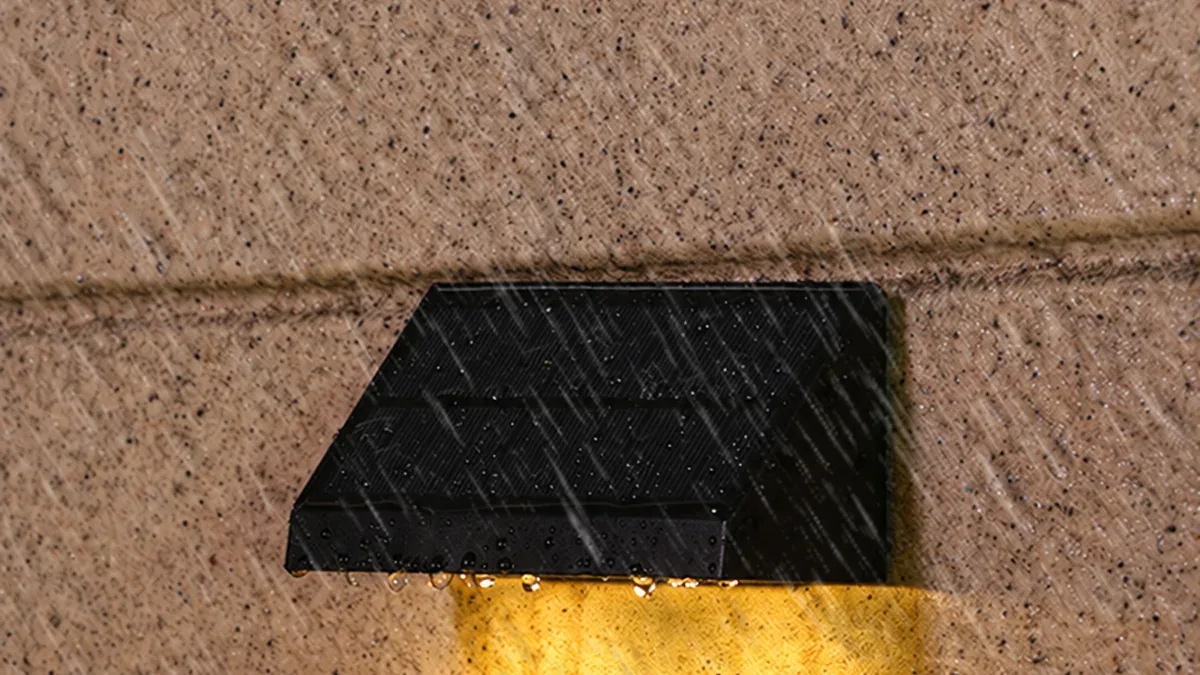
What IP65 actually says
IP stands for Ingress Protection. It is an international classification, published as IEC 60529, describing how well an enclosure keeps out solid objects and water. For outdoor lighting it is one of the few specifications that is standardised, comparable between suppliers, and testable — which is exactly why it is worth understanding.
A full IP65 statement covers two independent protections: 6 against solids, 5 against liquids. Neither digit says anything about mechanical strength, UV resistance, corrosion, condensation or service life. Those are separate properties, and a product can be genuinely IP65 while still failing outdoors in two years.
Reading the two digits
The first digit runs from 0 to 6 and covers solids: 0 is no protection, 4 protects against objects larger than 1 mm, 5 is dust-protected, and 6 is dust-tight. The second digit runs from 0 to 8 and covers water: 4 is splashing water, 5 is water jets, 6 is powerful water jets, and 7 and 8 cover temporary and continuous immersion.
Read together, IP65 is dust-tight plus water jets; IP44 is protection against objects over 1 mm plus splashing water; IP66 is dust-tight plus powerful water jets. Note that the pairs are not a ladder — IP54 has better dust protection than IP44 but the same water protection, and an IP65 product is not automatically better than IP66.
| Code | Solids (first digit) | Water (second digit) | Where it is appropriate for a solar light |
|---|---|---|---|
| IP44 | Objects larger than 1 mm | Splashing water | Under a porch, pergola or roof overhang only |
| IP54 | Dust-protected | Splashing water | Sheltered patios, covered walkways |
| IP65 | Dust-tight | Water jets from any direction | Exposed gardens, facades, rainy climates — the practical baseline |
| IP66 | Dust-tight | Powerful water jets | Coastal, wash-down, public and security installations |
| IP67 | Dust-tight | Temporary immersion | Ground-level fixtures in flood-prone areas |
Which rating for which installation
Specify by installation position, not by product category. A wall light under a balcony overhang sees far less water than the same model on an exposed gable end, and a step light recessed into a riser sees more standing water than a spotlight aimed at a tree.
In practice: IP44 for genuinely covered positions, IP65 for anything exposed, IP66 for coastal sites where salt spray and hose-down cleaning are normal, and IP67 for fixtures at ground level where water can pool. If a project is being specified by a landscape architect, the IP requirement should come from the drawing set, not from the catalogue.
What IP65 does not tell you
This is where most outdoor lighting failures happen, and none of it is covered by the IP code.
UV ageing. Unstabilised plastics chalk, yellow and become brittle under sustained sunlight. A housing can still be dust-tight while its surface has degraded enough to crack at a screw boss. UV-stabilised PC or die-cast aluminium avoids this; thin commodity ABS does not.
Gasket life. A compression gasket that passes the ingress test when new can take a permanent set after two summers of thermal cycling. Once it stops sealing, the product is no longer IP65 in service even though the label is unchanged.
Condensation. A sealed enclosure that heats by day and cools by night can draw moisture inward unless there is a breather membrane or a designed expansion volume. Water inside a sealed IP65 housing is a common field failure that no ingress test predicts.
Corrosion. IP says nothing about salt spray or galvanic corrosion at dissimilar-metal joints, which matters for coastal projects.
How to verify a claimed IP rating
A printed IP65 on a box is a claim; a test report is evidence. Ask for the report, and read four things in it: which standard and edition it was tested to, the exact model and configuration tested, which laboratory issued it, and whether the tested sample matches the product you are ordering.
Configuration matters more than buyers expect. A different cable gland, a different gasket material, an added sensor lens or a change from ultrasonic welding to screws can all invalidate the tested configuration. If your order includes a custom logo plate on the front cover, ask whether that changes the sealing.
Where no report exists, the honest answer is that the rating is unverified — not that it is false. Treat it as unverified and either commission testing or downgrade the claim in your own marketing.
What this means for a wholesale buyer
IP is one of the few specifications you can turn from marketing into a contract term. Put the code and the installation position into the purchase order, attach the test report, and define what happens on failure: replacement, credit or return.
Be explicit about the matched configuration. If your SKU has a different housing colour, a logo plate or a sensor variant, confirm in writing that the report covers it, or that the factory will re-test.
For your own listings, describe the rating accurately. Claiming IP65 on an IP44 product is a compliance and platform-listing risk in most markets, and it is the kind of claim a competitor can test. If you need IP66 for a project, say so at quotation stage — retrofitting a better gasket to an existing housing is usually a tooling change, not a part change.
Finally, treat the IP rating as one line in a durability specification rather than the whole of it. The questions that predict year-three failures are about housing material, gasket material, breather design and how the LED heat path is isolated from the cell.
Common mistakes
Buying IP44 for an exposed position because the sample looked sealed. The sample was probably assembled by hand in a clean room, not by a production line at rate.
Assuming IP65 covers immersion. It does not; that is IP67 or IP68, and the difference matters for step lights and ground fixtures.
Assuming a higher IP number means a better product overall. An IP68 fixture with an unstabilised housing and no thermal design can still fail in a season.
Accepting a certificate whose model number does not match the SKU on the invoice. This is the single most common documentation gap we see in supplier files.
Specification checklist
Use this when you request quotations, so every supplier answers the same questions.
| Question | Why it matters |
|---|---|
| Which IP code, for which installation position? | Prevents an IP44 part being sold into an exposed position |
| Is there a test report for this exact model? | A claim on a box is not evidence |
| Which same-configuration changes were covered? | Colour, logo plate and sensor variants can void the tested configuration |
| What is the housing and gasket material? | Predicts UV and compression ageing better than the IP code does |
| Is there a breather membrane or expansion volume? | Condensation inside a sealed fixture is a common field failure |
| What is the warranty position on water ingress? | Turns the specification into a commercial term |
Bottom line
IP65 means dust-tight and protected against water jets, and for outdoor solar lighting it is the sensible baseline for anything installed in the open. IP44 belongs under cover, and IP66 belongs on coasts, public sites and anything that gets hosed down.
The rating is a starting point, not a durability guarantee. Verify it with a report that matches your exact model, then ask separately about housing material, gasket design and condensation — those are what decide whether the product is still working in year three. See the IP65-rated solar spotlights and floodlights we supply, or read our wholesale selection guide for how IP fits into a full specification.
Frequently Asked Questions
Yes for typical rain and garden-hose exposure. IP65 is dust-tight and tested against water jets from any direction, which is why it is the usual minimum for exposed garden and wall lights. It does not cover immersion, and it does not guarantee the gasket still seals after several seasons.
Both are dust-tight. The second digit differs: 5 means protection against water jets, 6 means protection against powerful water jets at higher flow. IP66 is the safer choice for coastal sites, public installations and equipment that is routinely washed down.
The water protection is adequate, but salt spray and galvanic corrosion are separate problems that the IP code does not address. Ask specifically about the housing alloy, the coating and the fasteners, because unprotected steel screws in an aluminium housing are a common coastal failure.
It should, which is why the rating belongs in the purchase order. If the product is specified as IP65 for an exposed position and water enters the housing, that is a specification failure rather than normal wear — but only if the requirement and the matching test report are documented before shipment.
Related Pages
Request IP test reports and housing specifications for the models you are considering.
Contact Our TeamReferences
1. International Electrotechnical Commission (IEC) — IEC 60529 — Degrees of protection provided by enclosures (IP Code)
1989, with Amendments 1 (1999) and 2 (2013)
https://webstore.iec.ch/en/publication/2452Cited for: The meaning of each digit in the IP code: solids 0-6 (6 = dust-tight) and water 0-8 (5 = water jets, 6 = powerful water jets, 7/8 = immersion).
2. European Commission — RoHS Directive — restrictions on hazardous substances
Directive 2011/65/EU, page maintained by DG Environment
https://environment.ec.europa.eu/topics/waste-and-recycling/rohs-directive_enCited for: That material and substance compliance is a separate requirement from ingress protection for equipment placed on the EU market.
Written by the Lumazento quality team from inspection and supplier-documentation work. IP definitions follow IEC 60529 as cited above. Statements about UV ageing, gasket compression and condensation describe general material behaviour and design risk; they are not test results from our own laboratory, and we do not publish fixture-level ageing data unless a specific test report is referenced.