
Direct Answer
ABS is cheaper, lighter and moulds complex shapes, which makes it the right housing for most residential solar lights when it is UV-stabilised. Die-cast aluminium dissipates heat better, holds threads and resists impact, so it suits higher-output fixtures, coastal sites and long warranties. Choose by exposure, output and warranty length rather than by which material sounds more premium.
Key Takeaways
- ABS wins on cost, weight and shape freedom; aluminium wins on heat, threads and impact resistance.
- The weak point of ABS is ultraviolet exposure and heat build-up, both of which can be engineered around with stabilisers and internal layout.
- The weak point of aluminium is coating and cost: an uncoated or badly coated casting corrodes at the edges and around fixings.
- Specify the grade, not the family: UV-stabilised ABS and a stated coating thickness mean more than the word aluminium on a page.
What the two materials actually are
ABS is a thermoplastic: acrylonitrile butadiene styrene. It moulds at relatively low temperature, takes colour through the resin, holds fine detail and survives knocks without shattering. Those properties explain why it dominates the housing of consumer outdoor lighting, especially in the entry and mid tiers.
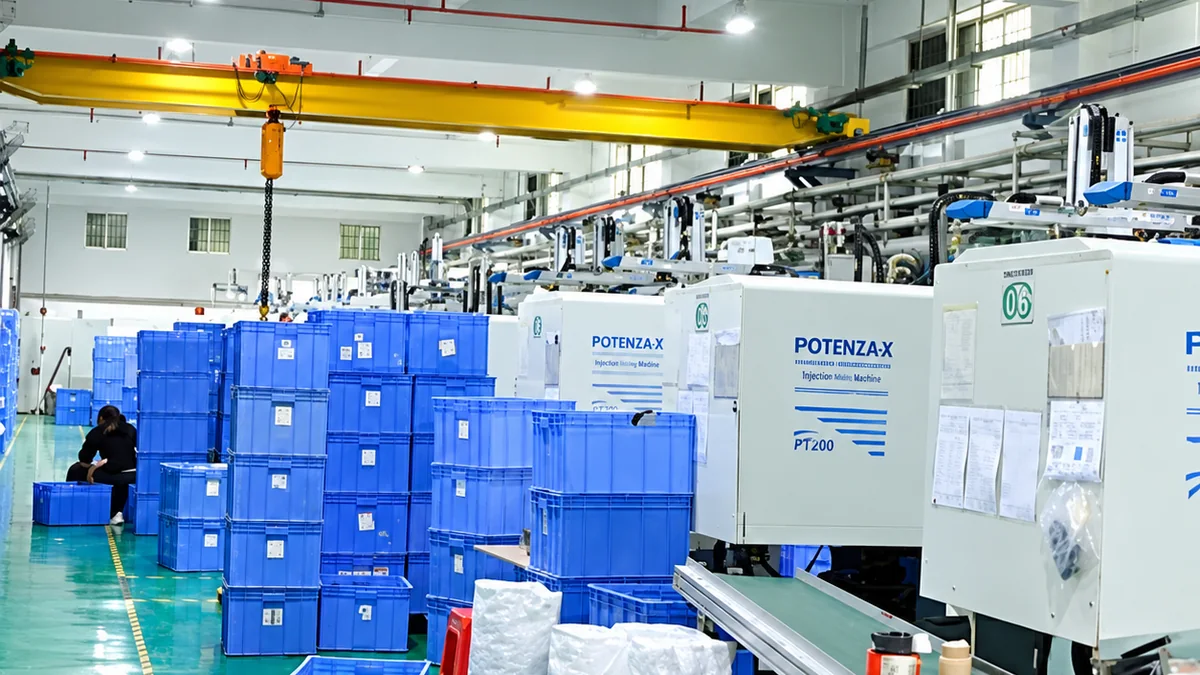
Die-cast aluminium is a metal casting produced by injecting molten alloy into a steel mould under pressure. It is stronger, conducts heat, and accepts a machined thread. It is also heavier, needs a surface finish, and costs more per part once tooling and finishing are counted.
The comparison is not really plastic against metal in the abstract. It is two different sets of trade-offs between cost, thermal behaviour and the environment the fixture will live in for the next five years.
Why ABS wins on shape and cost
An injection mould for an ABS housing can produce complex geometry in one shot: integrated clip features, a lens seat, a battery compartment, screw bosses and a cable entry. That reduces part count, which reduces assembly labour, which is a large share of the cost of a small fixture.
Colour is another advantage. ABS can be pigmented through the material, so a private-label range can offer black, grey, white or a brand colour without a separate painting step. Aluminium generally needs a powder coat or anodising to reach the same appearance, which adds process steps and creates a surface that can chip.
The tooling cost is lower too, which matters when a buyer wants a custom housing at a realistic volume. A steel die-casting tool is a substantially larger investment than an injection mould, and that investment has to be recovered across a much bigger order quantity.
Weight follows the moulding decision. A plastic fixture can be fixed with two screws and a wall plug, while a comparable aluminium casting may need a bracket, a masonry anchor and a second pair of hands on a ladder. For a retailer selling to homeowners who install the product themselves, that difference decides whether the fixture is bought at all.
Heat, ultraviolet light and two ageing paths
ABS ages in two ways that matter outdoors: ultraviolet light attacks the polymer chain, and heat accelerates the process. Unstabilised ABS exposed to sun will chalk, yellow and eventually become brittle, and a brittle housing is one impact away from a crack that lets water in.
The engineering answer is a UV-stabilised grade, sometimes with a painted or co-extruded surface layer. Specifying UV-stabilised ABS rather than ABS is the single most useful sentence a buyer can add to a purchase order, because the price difference is small and the lifetime difference is not.
Heat also comes from the electronics rather than the sun alone. A sealed housing with a 5 W LED and a charging battery warms up internally, and that warmth sits right next to the cell. Aluminium helps here because the casting spreads and radiates heat, which is why higher-output floodlights and spotlights tend to use metal even when the matching wall light in the same range is plastic.
Where both materials are used, the design detail that matters is the thermal path between the LED board and the shell. A metal casting with the board screwed directly to a boss conducts heat out; the same board on plastic stand-offs in a plastic housing keeps it in. Battery placement follows the same logic: a cell mounted directly behind the LED sits in the warmest part of the product, while one in a separate compartment at the other end of the fixture lasts longer for no extra material cost.
Coating, corrosion and coastal installations
Aluminium does not rust like steel, but it does corrode, particularly at cut edges, around fixing holes and anywhere the coating is thin. Coastal installations are the test case: salt-laden air accelerates pitting, and a fixture that looks fine inland can fail within a season on a seafront.
A proper die-cast housing therefore has a documented finish: a pretreatment, a stated coating type and a measured film thickness. Without those, the word aluminium on a datasheet says very little about how the product will look in three years.
ABS has the opposite coastal problem. It does not corrode, but salt deposits and ultraviolet light together accelerate surface degradation, and a scratched housing is a starting point for cracking. Neither material is maintenance-free at the coast; the question is which failure you can design against.
Threads, brackets and repairability
Small fixtures are attached with small screws, and screws need threads that survive being tightened. Metal castings and metal inserts hold a thread properly and can be opened and resealed several times. A plain plastic boss can strip on the second or third assembly, which turns a serviceable fixture into a sealed one.
This is why many well-designed ABS housings use brass or stainless threaded inserts at the mounting points rather than relying on the polymer. It is a small cost that shows up in the specification as a line item and in the field as a bracket that stays tight.
Repairability matters commercially because a replaceable battery extends the useful life of a fixture well beyond the first cell. A housing designed to be opened has to be designed for it: a gasket that reseats, screws rather than clips, and a compartment that does not require cutting the product apart.
The gasket itself is a specification item, not an accessory. Silicone holds its compression over a wider temperature range than many cheaper alternatives, and a gasket that has hardened cannot be reseated no matter how carefully the housing is reassembled. If a product is sold as serviceable, the seal has to be supplied as a spare part, and the screw torque should be stated so the seal is neither under-compressed nor crushed.
The two materials compared
The table below compares the two housings on the factors that show up in the field rather than in a brochure.
| Factor | UV-stabilised ABS | Die-cast aluminium |
|---|---|---|
| Weight | Light, which helps on wall and fence mounting | Heavier, needs a firmer fixing and a stronger bracket |
| Tooling cost | Lower, so custom shapes are viable at moderate volume | Higher, so tooling is usually amortised over large orders |
| Shape freedom | High: clips, bosses and lens seats moulded in one shot | Moderate: draft angles and machining limits apply |
| Colour | Pigmented through the material, no painting step | Requires powder coating or anodising |
| Heat dissipation | Poor, so internal heat stays near the battery | Good, which suits higher-output fixtures |
| Impact resistance | Good until UV embrittlement sets in | High, and it dents rather than cracks |
| Coastal exposure | No corrosion, but surface chalking and salt staining | Corrosion risk at edges and fixings unless well coated |
| Typical use | Entry and mid-tier residential fixtures | Floodlights, spotlights, premium and project ranges |
How to specify either material properly
For ABS, ask for the grade and the stabiliser, the wall thickness at the thinnest point, and whether the mounting bosses have metal inserts. Ask as well whether the housing is painted or moulded in colour, because a painted plastic part introduces a coating failure mode that a pigmented part does not have.
For aluminium, ask for the alloy, the casting method, the pretreatment, the coating type and the film thickness in micrometres. Add a salt-spray duration if the product is destined for a coastal market, and specify stainless fixings so the screws do not become the corrosion site.
For both, ask about the gasket. Ingress protection is defined by IEC 60529, and the rating depends on the seal as much as the shell, so a well-made housing with a poorly specified gasket still fails. Our explainer on what IP65 means for outdoor lights covers how to read the rating, and why solar lights stop working shows what water ingress looks like in practice.
The production base we work with includes tooling, injection moulding and assembly, which is why material changes are a specification conversation rather than a catalogue one. The factory section of our about page sets out those capabilities.
What this means for a wholesale buyer
Material is a price-tier decision before it is a quality decision. A UV-stabilised ABS housing is the correct choice for a retail garden light at a competitive price, and an aluminium housing is the correct choice where the product has to survive a coastal site or carry a long warranty. Buying aluminium at an ABS price usually means buying a thin casting with a thin coating, which is the worst of both.
Ask what problem the material is solving in each SKU. If the answer is heat from a high-output LED, aluminium earns its cost. If the answer is appearance, a pigmented ABS housing with a good surface finish may look identical and cost less.
Then test the decision rather than the datasheet. An ultraviolet chamber result and a salt-spray result tell you how a sample behaved under defined conditions, and both are worth asking for on any premium SKU. Without them, the material claim is a statement of intent.
Bottom line
ABS and aluminium are both appropriate housings for outdoor solar lighting, and neither is inherently better. ABS buys shape freedom, colour and cost; aluminium buys heat handling, thread strength and impact resistance.
The decision should follow exposure, output and warranty length, and the specification should name the grade and the finish rather than the material family. Our wall light range and spotlight and floodlight range show how the same product family is built differently across those tiers.
Frequently Asked Questions
Not if it is made from a UV-stabilised grade and designed with adequate wall thickness. Unstabilised ABS will chalk, yellow and embrittle over successive summers, and a brittle housing cracks on impact. The grade matters far more than the material family, and it is a line item worth putting in the purchase order.
It is better on mechanical strength but not automatically better on corrosion. Aluminium pits at cut edges and fixings in salt air unless the casting is properly pretreated and coated, and stainless fixings are used. A well-coated aluminium housing outperforms a poorly coated one by a wide margin.
Because heat has to go somewhere. A high-output LED plus a charging battery warms the inside of a sealed housing, and that heat shortens battery life. A die-cast aluminium body spreads and radiates that heat, while a plastic housing keeps it close to the cell.
Not directly, because the IP rating describes the assembled enclosure under defined test conditions rather than the material. In practice the material affects how long the rating holds, since a housing that warps, chalks or cracks in ultraviolet light will eventually lose the seal that earned the rating.
Related Pages
Tell us the installation environment and warranty length and we will recommend the housing material and finish that fit.
Contact Our TeamReferences
1. International Electrotechnical Commission (IEC) — IEC 60529 — Degrees of protection provided by enclosures (IP Code)
1989, with Amendments 1 (1999) and 2 (2013)
https://webstore.iec.ch/en/publication/2452Cited for: That the IP rating is a property of the assembled enclosure under defined test conditions, which is why the housing material and gasket design both affect how long it holds.
2. European Commission — RoHS Directive — restrictions on hazardous substances
Directive 2011/65/EU, page maintained by DG Environment
https://environment.ec.europa.eu/topics/waste-and-recycling/rohs-directive_enCited for: The restrictions that apply to substances in electrical and electronic equipment, including the brominated flame retardants sometimes used in plastic housings.
Written by the Lumazento export desk. Material behaviour described here is general engineering guidance rather than test data from our own laboratory; we do not publish ultraviolet or salt-spray results for individual SKUs in this article. Ask for the grade, coating specification and test reports for the exact model you buy.