
Direct Answer
Choose solar wall lights when you need to light an area people walk through, such as an entrance, garage front or boundary wall, and pathway lights when you need to mark a line on the ground. Wall lights give more output and better security coverage but need a suitable vertical surface; pathway lights install anywhere with soil and cover a walkway far more cheaply per metre.
Key Takeaways
- Wall lights light an area; pathway lights mark a line. That single difference drives every other comparison.
- Wall lights need a wall in the right place and a panel that can still see the sun; pathway lights need soil and no shade.
- Per metre of illumination, pathway lights are cheaper, but they cannot light an entrance or deter anything.
- Most finished gardens use both, and the split is usually decided by where the light lands rather than by price.
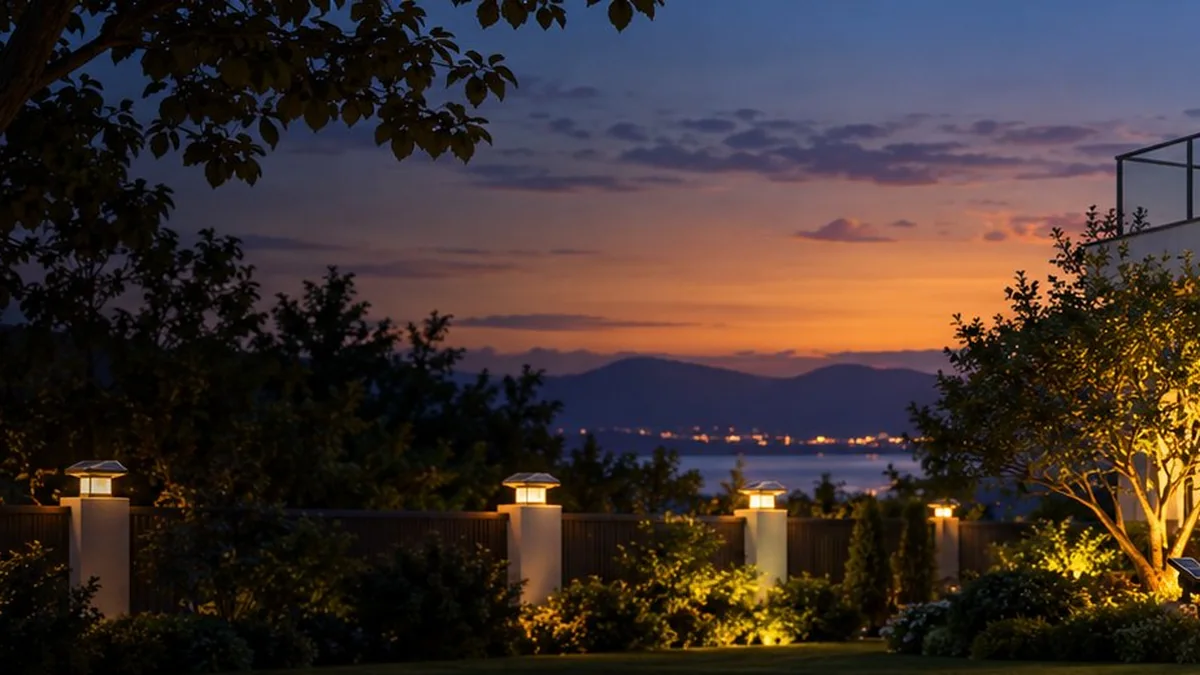
The difference in one sentence
A solar wall light illuminates an area from above; a solar pathway light marks a line from ground level. Everything else, from mounting to price to failure mode, follows from that.
This matters because buyers often compare the two as if they were interchangeable products at different prices. They are not. A wall light installed at 2.2 metres throws light down over a doorway or a stretch of facade. A path light at 40 centimetres lights the ground within roughly a metre of itself. One replaces a porch light; the other replaces a line of markers.
Mounting and installation effort
Wall lights need a vertical surface in a position that is both useful and sunlit. That combination is less common than it sounds: the wall beside a front door is often shaded by a porch roof, and the wall that faces the sun is usually at the back of the house. Fixtures with an adjustable panel or a separate panel on a cable solve this, at a higher cost.
Pathway lights need soil, gravel or a mounting stake position, and no shade. Installation is a push and a tap with a mallet, which is why they are the easiest product in the category to sell to a homeowner and the easiest for a contractor to install in volume.
Where a path runs along a wall, the two overlap: a low-mounted wall light can mark the same line as a stake light, and some projects use wall-mounted step lights for exactly that reason. It is worth checking the site before assuming a stake is required.
Mounting height deserves a decision of its own on wall lights. A fixture set at 2.2 metres spreads light over a wider area but throws a longer shadow from anything close to the wall, while one at 1.8 metres puts more light on the ground where feet actually are. For an entrance, the lower height is usually the better choice; for a facade wash, the higher one reads as architectural rather than functional.
The fixing itself is a returns issue in disguise. Wall lights are frequently mounted on rendered or insulated facades, where a short screw holds well enough to pass an installer's inspection and poorly enough to work loose within a season. Specify the fixing hardware, and say clearly in the installation instructions what substrate the bracket is designed for.
Coverage: area versus line
Coverage is where the cost comparison changes. A typical path light covers about a metre of walking line, so marking a twenty-metre path needs roughly fifteen to twenty fixtures. A wall light covers several square metres from one mounting point, so lighting an entrance needs one or two.
That gives each product a different cost curve. Per fixture, a wall light costs more. Per metre of path, pathway lights are usually cheaper because the fixtures are smaller and simpler. Per square metre of lit area, wall lights win decisively because one fixture does the work of many.
Buyers planning a mixed container should think in these units rather than in pieces, because a retailer restocking path lights is buying a different product from a contractor buying wall lights for a villa facade.
Output, glare and the beam question
Wall lights generally carry higher output, because they have more housing volume for a bigger panel and battery and because they are expected to light a doorway rather than a flowerbed. That extra output is also why they glare when aimed badly: a bright fixture at eye level in a narrow courtyard is uncomfortable, and a wide diffuser matters more than another hundred lumens.
Pathway lights are usually specified for even, low output. The failure here is the opposite one: too narrow a beam creates a bright pool with dark gaps between fixtures, which looks worse than a dimmer, wider spread. For path lighting, beam angle is a more useful specification than lumen count.
Both families are affected by the same constraint underneath: the panel has to fit the housing. A wall light can carry a larger panel than a stake light, which is one reason the higher output is achievable at all. The relationship between panel, battery and load is set out in how solar garden lights work.
Colour temperature also separates the two in practice. Wall lights sold for entrances usually sit at 3000 K or warmer, because a cooler white on a facade reads as security lighting rather than residential lighting. Path lights are more tolerant, and a slightly cooler output can help a walkway read as clearly marked rather than merely decorative. Two models at the same Kelvin value will look consistent side by side, which is what a buyer building a range should aim for.
Specifications compared side by side
The table below compares the two families on the decisions that actually differ. It describes the families, not a specific model, so confirm the numbers on the datasheet you are buying.
| Decision | Solar wall lights | Solar pathway lights |
|---|---|---|
| Mounting surface | Vertical wall, post or boundary | Soil, gravel or a hard-standing base |
| Installation effort | Drilling and fixings, often at height | Push stake, no tools required |
| What it lights | An area: doorway, facade, driveway | A line: walkway edge, bed border |
| Typical coverage | Several square metres per fixture | About a metre of path per fixture |
| Output band | Higher, often 100 to 400 lm | Lower, often 20 to 100 lm |
| Panel placement | Top face or adjustable arm, sometimes remote | Integrated in the head above the stake |
| Exposure | Rain and wind, usually above splash | Splash, soil moisture, garden sprays |
| Typical failure | Water at the top gasket, sensor faults | Leaning stake, water at the base seal |
Which one fails more often, and why
Pathway lights fail more often in the field, and the reason is environmental rather than electrical. They sit close to wet soil, they are watered, they are kicked, and their base seal is the lowest point of the product. A stake that leans after a season also changes the light distribution, which reads as a performance failure even when nothing has broken.
Wall lights face less standing water but more wind-driven rain and, on entrances, more physical contact. Their common failures are a hardened top gasket, a sensor that has fogged, and a bracket that was fixed into render rather than into masonry and has pulled away.
Both are covered by the same standard: IEC 60529 defines the IP code, and IP65 is the practical minimum for either family in an exposed position. What differs is where the water arrives, so the seal design that matters is different on each. The detail is in what IP65 means for outdoor lights.
When the answer is both
In a finished residential garden the two products do different jobs and rarely compete. The usual layout is a wall light at each entrance and on the garage front, with pathway lights marking the route between them. One provides safety and presence; the other provides guidance.
The commercial argument for stocking both is that they sell to the same customer in the same visit. A retailer that carries only path lights sends the wall light sale to a competitor, and a contractor specifying a villa needs both on one purchase order to keep the installation on schedule.
The case for choosing one is narrower: a rental property, a small courtyard or a single-application retail programme. In those situations, decide by where the light has to land. If it has to light a door, a wall light is the only option that works. If it has to mark a route, a wall light will do it badly and expensively.
There is also a sequencing argument. A project that installs wall lights first and path lights second can be phased across two delivery dates, which suits contractors working to a landscaping schedule. Splitting the order that way usually costs slightly more per unit than a single shipment, but it moves cash flow from the supplier's problem to the site's timeline, and it lets the second specification learn from how the first batch performs.
What this means for a wholesale buyer
Build the assortment around the installation mix in your market rather than around a single hero product. Markets with detached housing and gardens support both families; markets dominated by apartments sell far more wall and balcony fixtures than stake lights, because there is no soil to put a stake in.
Then compare suppliers on the specification that differs by family. For wall lights, ask about panel placement and whether a remote panel option exists, because the shaded-wall problem is the main reason a wall light underperforms. For pathway lights, ask about stake material, base seal design and beam angle.
Both families are in our range, and the solar wall light models and solar pathway light models list the specification per SKU so you can compare them line by line. If you are specifying a villa or garden project, the villa lighting application page shows how the two are typically combined.
Bottom line
Choose wall lights to light an area and pathway lights to mark a line. Wall lights cost more per fixture and need a suitable wall, but one unit covers what several stake lights cannot. Pathway lights are cheaper per metre and easier to install, and they do nothing for an entrance.
For most buyers the practical answer is a mix, with the ratio set by local housing stock. If you are deciding between control types next, PIR motion sensors versus dusk-to-dawn switching covers the choice that changes runtime most.
Frequently Asked Questions
They can mark a route if they are mounted low along the same edge, but they are an expensive way to do it. A wall light costs more per fixture and covers a shorter stretch of path than a stake light, so the usual approach is wall lights for entrances and stake lights for the route between them.
A wall light, because it mounts higher, covers more area and can carry a motion sensor with enough output to be useful when triggered. A path light lights the ground within a metre of itself, which marks a walkway but does not illuminate a doorway, a gate or a parked car.
You need a vertical fixing surface: a wall, a post, a pillar or a fence panel with enough rigidity. What matters as much as the surface is the sun exposure, since a wall in permanent shade will leave the panel undercharged even if the fixture itself is well made.
As a working rule, one fixture per metre of edge for even marking, or one every two metres if a dimmer, wider spread is acceptable. Driveway edges are usually longer than buyers estimate, so measure the run before ordering and allow for a few spares from the same batch.
Related Pages
Tell us the site layout and we will suggest a wall and pathway light mix with the specifications your market needs.
Contact Our TeamReferences
1. International Electrotechnical Commission (IEC) — IEC 60529 — Degrees of protection provided by enclosures (IP Code)
1989, with Amendments 1 (1999) and 2 (2013)
https://webstore.iec.ch/en/publication/2452Cited for: The two-digit structure of the IP code used to compare how wall-mounted and ground-level fixtures are protected against water.
2. U.S. Department of Energy — Solar Photovoltaic System Design Basics
Page maintained by the Solar Energy Technologies Office
https://www.energy.gov/eere/solar/solar-photovoltaic-system-design-basicsCited for: That panel placement and orientation determine how much energy a stand-alone system can collect, which is the constraint behind the shaded-wall problem.
Written by the Lumazento export desk. Output and coverage bands in this article are family-level ranges intended for shortlisting, not measured values for a specific product. Mounting heights and spacing rules are practical rules of thumb, not code requirements; check local electrical and planning rules where they apply.