
Direct Answer
Outdoor solar lights divide into six practical families: pathway and lawn lights for walkways, wall and facade lights for entrances, fence and step lights for edges and stairs, spotlights and floodlights for trees and security, portable and clip-on lights for temporary use, and decorative lights for patios and hospitality. The family should follow the job the light has to do, not the shape someone finds attractive online.
Key Takeaways
- Six families cover almost every outdoor use: pathway, wall, fence and step, spotlight and floodlight, portable clip-on, and decorative.
- Choose by mounting surface and coverage first; the product name is a description, not a specification.
- Wall and pathway lights are the volume sellers, but fence, step and spotlight models raise the average order value.
- Every family has one specification that decides its reputation in the field: panel size, IP rating, sensor behaviour or battery capacity.
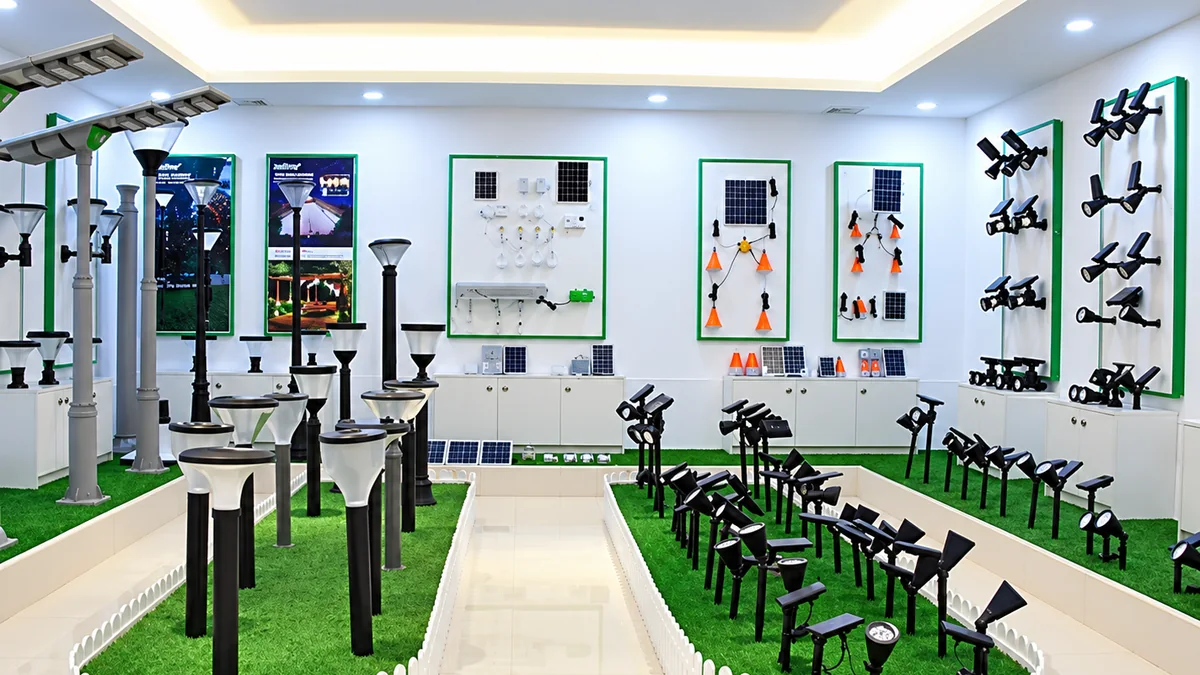
The six families buyers actually stock
The outdoor solar lighting category looks chaotic from the outside because marketplaces list hundreds of variations. From a trade buyer's side it is much narrower: almost every product is a variation on six families, and each family solves a different installation problem.
- Pathway and lawn lights, mounted on a stake at ground level
- Wall and facade lights, fixed to a vertical surface
- Fence and step lights, mounted low on a flat or angled edge
- Spotlights and floodlights, aimed at an object or an area
- Portable and clip-on lights, moved between locations
- Decorative lights, bought for appearance as much as for illumination
Pathway and lawn lights
Pathway lights are the highest-volume product in the category, and the simplest to explain: they mark the edge of a walkway, a driveway or a garden bed so people can see where to step after dark. Mounting is a ground stake, so installation needs no electrician, no trench and no permission from a landlord.
The most common field complaint is not brightness but alignment. A stake that leans after a season throws light sideways, and a fixture that produces a hotspot looks worse than a cheaper one that spreads light evenly. Buyers should look at the stake design and the diffuser, not only the lumen figure.
The second common complaint is water in the housing. Pathway fixtures sit close to wet soil and are often sprayed during watering, so the base seal and the cable entry are more exposed than on a wall fixture. This is where a genuine IP65 build separates from a label. The code itself is defined in IEC 60529, and we explain the digits in what IP65 means for outdoor lights.
Wall and facade lights
Wall lights cover entrances, garage fronts, boundary walls and balconies. They are usually brighter than pathway lights because they light an area people walk through rather than a line on the ground, and they often carry a motion sensor for security use.
The design constraint is the panel. A wall fixture needs a solar panel that faces the sun while the light faces away from the wall, so the panel is often on an adjustable arm or on the top face. A tiny panel on a large housing is the clearest sign of a product that will not keep up in winter.
Wall lights also have the widest spread of build quality. The same silhouette can be sold with a die-cast aluminium body and a glass diffuser, or with thin plastic and a glued lens, at very different price points. Material choice decides how the product looks after two summers, which is covered in ABS versus aluminium housings.
Fence and step lights
Fence and step lights are low-level fixtures that mark a boundary, a stair edge or a deck step. They exist mainly for safety: a lit step edge prevents falls, and a lit fence line defines a property without a floodlight.
Because they mount low, they are the family most exposed to splash, garden debris and, in cold markets, standing snow. A step light with a poor gasket fails faster than any other type. Coverage also matters more than output: a step light should illuminate the tread, not the garden behind it.
Commercially, this family is a useful add-on. A retailer that already sells pathway lights can stock step and fence models to the same customer with almost no extra education, which lifts the average basket without adding a new audience.
Spotlights and floodlights
Spotlights throw a narrow beam at a tree, a sign, a wall or a feature. Floodlights spread a wider pool of light for driveways, yards and security. Both need more output than a path light, which means a larger panel and a larger battery, and often a separate panel on a cable so the light can be aimed while the panel still faces the sun.
This family is where buyers get the most value from a motion sensor, because a floodlight that only runs at full output when something moves can use a much smaller battery than one that runs all night. The trade-off is that a badly tuned sensor produces nuisance triggering, which is the most common review complaint in the category.
Spotlights are also the family where the beam angle has to be in the specification. Two 300 lumen fixtures with different optics are not interchangeable, and a buyer comparing quotes without a beam angle is comparing two different products.
Portable and clip-on lights
Portable and clip-on lights are the one family sold on flexibility rather than installation. They clip to a shed frame, a boat rail, a tent or a balcony bar, and they usually combine a small panel with a battery and a hook or magnet.
Because they are handled rather than fixed, the specification priorities shift: the switch has to survive repeated use, the housing has to survive being dropped, and the charging port, where there is one, is the first thing to fail. Output per unit is lower than a fixed fixture, and that is acceptable for the use case.
For a buyer, this family works as a seasonal or impulse item more than as a project product. It also tends to have a different sales channel from the rest of the range, which matters when you plan a container mix.
Decorative lights
Decorative lights are bought for how they look in daylight as much as for what they do at night: tabletop lanterns, colour-changing wall pieces, plant stand lights and seasonal shapes. The buyer is often a gift purchaser, a hospitality operator or a retailer building a display.
Technically they are the least demanding family, which also makes them the easiest to get wrong. A decorative fixture with a small panel and a colour-changing LED can drain a small cell quickly, and the result is a product that looks good in a photograph and disappointing on a table after two hours.
For trade buyers, the useful question is whether the decorative function is the point or a bonus. If the product is a gift, appearance and packaging carry the sale. If it is meant to light a patio table, it belongs in a different conversation about runtime.
Choosing by application instead of by product name
The fastest way to build an assortment is to start from the installation, not the catalogue. Ask where the light will be fixed, what it has to illuminate, and who will install it. Those three answers narrow the family immediately.
| Where the light is needed | Family that usually fits | Why it fits |
|---|---|---|
| Walkway, driveway edge or garden bed | Pathway and lawn lights | Stake mounting needs no wiring and marks a line on the ground |
| Entrance, garage front or boundary wall | Wall and facade lights | Mounts to a vertical surface and covers an area people walk through |
| Stair edge, deck step or fence line | Fence and step lights | Low mounting lights the tread or the boundary rather than the garden |
| Tree, sign, facade feature or yard | Spotlights and floodlights | Aimed beam and higher output for distance or coverage |
| Tent, shed, boat or rental unit | Portable and clip-on lights | Moves between locations and needs no installation |
| Patio table, hospitality setting or gift | Decorative lights | Appearance and packaging carry the purchase decision |
What this means for a wholesale buyer
An assortment built only from the cheapest family leaves money on the table. Pathway lights bring customers in, but wall, step and spotlight models sell to the same customer at a higher unit price, and they use the same panel and battery supply chain, so adding them does not add a new sourcing problem.
The reverse mistake is stocking every family at once. Each family has its own failure mode and its own documentation needs, and a buyer with six weak SKUs learns less than a buyer with three strong ones. A common pattern that works is one entry SKU, two mid-tier models and one premium model within the highest-volume family, then one or two models from an adjacent family.
Finally, treat the IP rating and the warranty terms as family-level decisions. A step light and a floodlight at the same IP rating do not face the same conditions, so the same rating can be adequate in one family and marginal in another. Our product range lists the specifications per family, and the fence and step light range shows how low-mount fixtures are built differently.
Bottom line
There are six outdoor solar lighting families, and the right one is decided by where the fixture mounts and what it has to illuminate. Names on a marketplace listing are marketing; mounting surface, coverage and IP rating are the specification.
If you are building a range, start with the application mix in your market, then choose one or two models per family and compare them on panel, battery and control behaviour. For the illumination side, see how solar garden lights work, or look at the decorative range if appearance is the selling point.
Frequently Asked Questions
A pathway or lawn light on a ground stake is almost always the right answer, because it needs no wiring and throws light along the walking line. Look for a diffuser that spreads light evenly rather than a narrow hotspot, and confirm the fixture is rated for the wet conditions at ground level.
A solar floodlight can be bright enough for a driveway or yard, but only with a panel and battery sized for that output. Most practical security fixtures use a motion sensor so the light runs at full output only when triggered, which keeps the battery requirement manageable without reducing the light level when it matters.
Usually yes, and it is a sensible way to test a market. Confirm the minimum quantity per model and the packing arrangement first, because mixed cartons add handling work at the factory and can change the unit cost slightly compared with a single-model container.
They face harsher conditions because they sit close to wet ground and are often sprayed or covered in snow, so a higher rating and better gasket design are worth paying for. The same IP65 figure can be adequate on a sheltered wall and marginal on a step, which is why the mounting position should be part of the specification.
Related Pages
Tell us which applications you need to cover and we will suggest a model mix for your market.
Contact Our TeamReferences
1. U.S. Department of Energy — Solar Photovoltaic System Design Basics
Page maintained by the Solar Energy Technologies Office
https://www.energy.gov/eere/solar/solar-photovoltaic-system-design-basicsCited for: That a stand-alone photovoltaic system is sized around the relationship between panel output, storage capacity and the load it has to serve.
2. International Electrotechnical Commission (IEC) — IEC 60529 — Degrees of protection provided by enclosures (IP Code)
1989, with Amendments 1 (1999) and 2 (2013)
https://webstore.iec.ch/en/publication/2452Cited for: The meaning of the two digits in an IP rating, used here to explain why the same rating performs differently across mounting positions.
Written by the Lumazento export desk. The families described here are the ones we supply, but the guidance is written to be usable against any supplier's catalogue. No performance figures in this article are measurements of a specific model; confirm panel, battery and IP specifications on the datasheet for the SKU you buy.